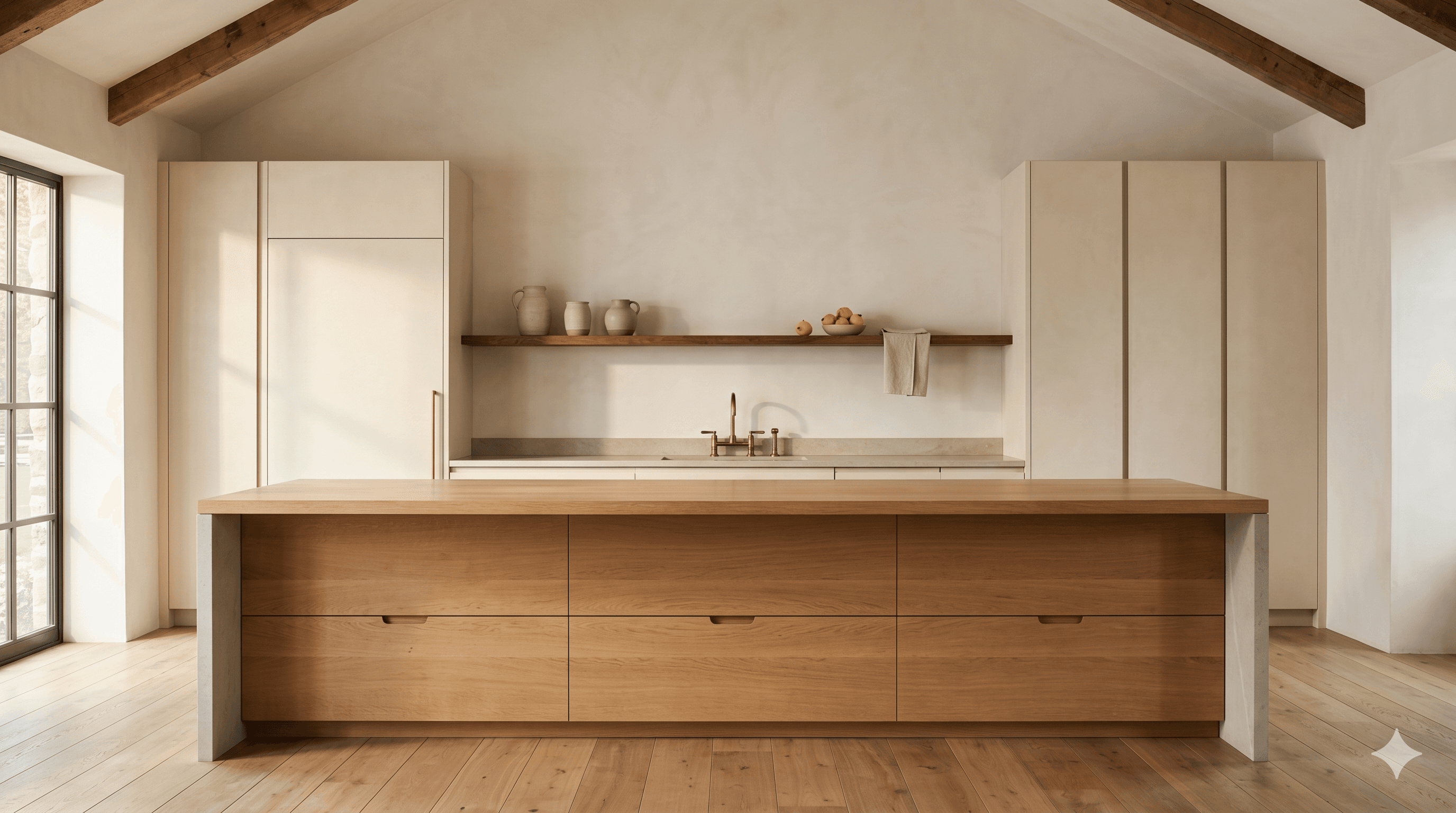
Cabinets built for accessibility.
Lower counter heights. Knee space at sinks. Pull-out drawers in place of shelves. Tile-edge hardware. Stock and custom options.
Stock aging-in-place cabinets
Standard-size vanity bases and pull-out drawer modules for retrofits and accessibility upgrades.
Custom aging-in-place cabinets
Custom-built kitchens and baths specified for accessibility — knee space, raised dishwashers, lowered counter zones, easy-grip hardware.
What accessibility cabinetry actually means
The standard kitchen is built around an assumed user: 5'6"–6'0" tall, full hand strength, full balance, good vision. That assumption holds for most of life. It stops holding for almost everyone eventually.
Aging-in-place cabinetry is not a hospital-room aesthetic. The finished kitchen reads as a well-built custom kitchen — same door styles, same finish options, same hardware tier as anything else we supply. The accessibility choices are in the layout, the drawer mix, the hardware function, and the lighting design. None of them read as "accessibility features."
Most of these choices are also better cabinetry regardless of age. A kitchen with drawer banks instead of lower-door cabinets is easier to use at any stage. Lever pulls outperform round knobs every time. Layered lighting is just good lighting. The accessibility-driven spec tends to be the better spec.
Six choices that change daily usability.
Drawers, not lower-door cabinets.
Doors require bending and reaching into a dark interior. Drawers bring contents out to the user. Every aging-in-place kitchen we supply maximizes drawer banks in the base cabinets — full-extension, soft-close, operable one-handed.
Roll-under sinks and counters.
An ADA-style roll-under sink station provides seated counter access. Built with removable panels so the cabinetry reads as standard when not in use.
Lever pulls, no knobs.
Round knobs are difficult to grip with reduced hand strength. Lever pulls and D-pulls operate for any hand. Standard spec on every aging-in-place order.
Layered lighting.
Aging eyes require 3–4x the light of younger eyes. Layered lighting — overhead, under-cabinet, in-cabinet, toe-kick — provides generous workspace illumination without harsh glare.
Lower counter heights.
Standard 36-inch counter heights are tiring for extended standing. We supply sections at seated-task height (30 inches) or build adjustable-height counters for primary work zones.
Pull-out shelves, not deep cabinets.
Pantry shelves on full-extension hardware bring contents into view on every open. Nothing buried, nothing forgotten.
Three more in the bathroom.
Curbless shower coordination + vanity heights.
Vanity cabinetry sized and positioned for curbless shower entries, with toe-kick clearance for shower chairs and walking aids.
Knee space at the vanity.
Open knee space below the sink for seated use, with concealed plumbing behind a removable panel so the cabinetry reads as standard.
Grab bar–ready blocking.
We coordinate with tile and framing trades to block walls for grab bars now — even if they are not installed yet — so adding them later is a 20-minute job rather than a rebuild.
How every Vitrin cabinet is built
The construction bar is the same for Vitrin Stock and Vitrin Signature. The difference is how each cabinet is made, not how well.
Plywood boxes
1/2-inch plywood sides, 3/4-inch top, bottom, and shelves. No particleboard.
Dovetail drawers
Solid-wood dovetail drawer boxes — 5/8-inch sides, captured plywood bottoms.
Blum hardware
Soft-close hinges and undermount slides on every drawer and door.
Finished in-house
Spray-finished in our dust-controlled booth. Touch-up kit included with every order.
Talk to us about accessibility
Two options, one shop. We'll help you choose the right tier.